

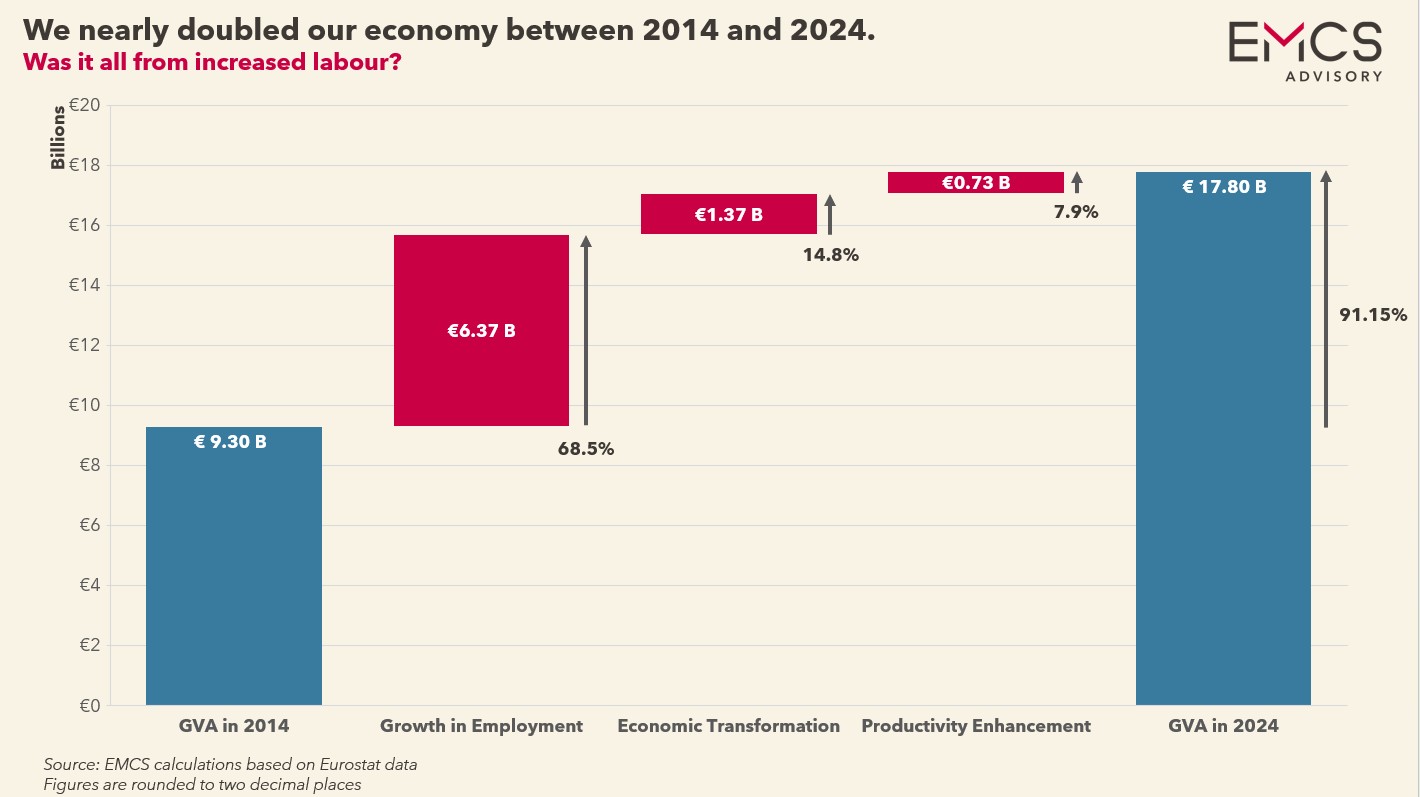
In 2014 the GVA of the Maltese economy indexed to 2020 prices stood at €9.3B. By 2024 this increase to €17.8B again indexed to 2020 prices, meaning a growth of 91.15% (a 100% increase would mean doubling the economy). First of all, what do we mean by “indexed to 2020 prices”? We use a price index to make sure that the GVA growth is not due to simply because of inflation (prices going up). By way of an example, if a loaf of bread cost €1 in 2014 and €2 in 2024, the "economy" doubled in price, but you still only have one loaf of bread. Using 2020 prices allows us to see the real volume of growth.
However, going back to our original point, what were the real driving factors behind this growth?
To help everyone understand, one can view the growth engine of an economy like a three-cylinder engine. On one hand, you have the labour cylinder by simply adding more people into the economy, then you also have the efficiency cylinder whereby one keeps doing the same job better or with better tools (productivity) or the structural cylinder, whereby workers within the economy move from low-value sectors to high-value sectors (Economic Transformation).
In 2014 labour in terms of Full Time Equivalents (FTEs) stood at 192,363 which by 2024 increase by 68.5% to 324,132FTEs. GVA per FTE also increase from €48.5k to €55.0k equating to an increase of 13.44%
Now very often, perhaps because it is the simplest way, GVA per FTE on a national level is confused with productivity when in reality this is also affected by economic transformation. Economic transformation in simple terms refers to the benefits in total output experienced when an economy moves towards higher output sectors. Perhaps it’s easier to explain with an example.
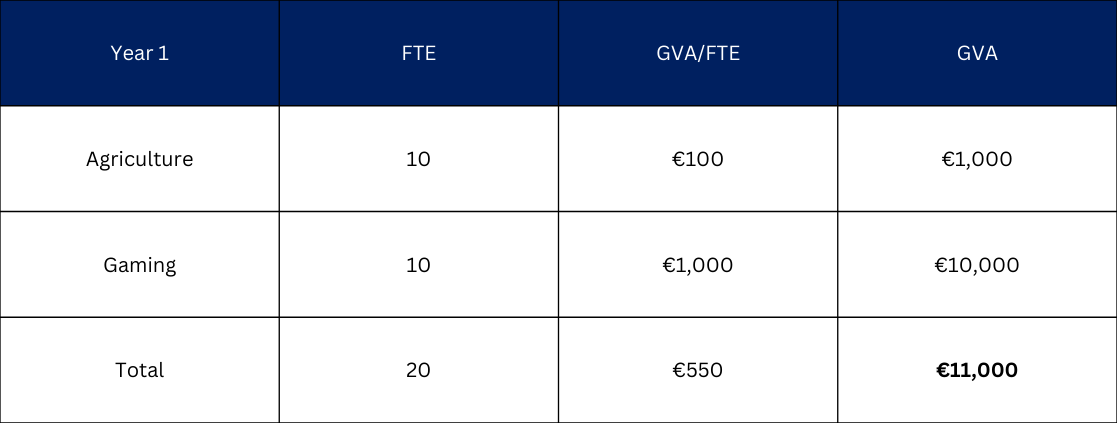
Let’s assume an economy is composed of just 2, very contrasting sectors, Agriculture and Gaming. In this hypothetical example, each worker in Agriculture generates €100 while every worker in Gaming generates €1,000. There are 10 FTEs per sector so a total of 20 FTEs which result in €11,000 and a GVA per FTE at an economy level of €550.
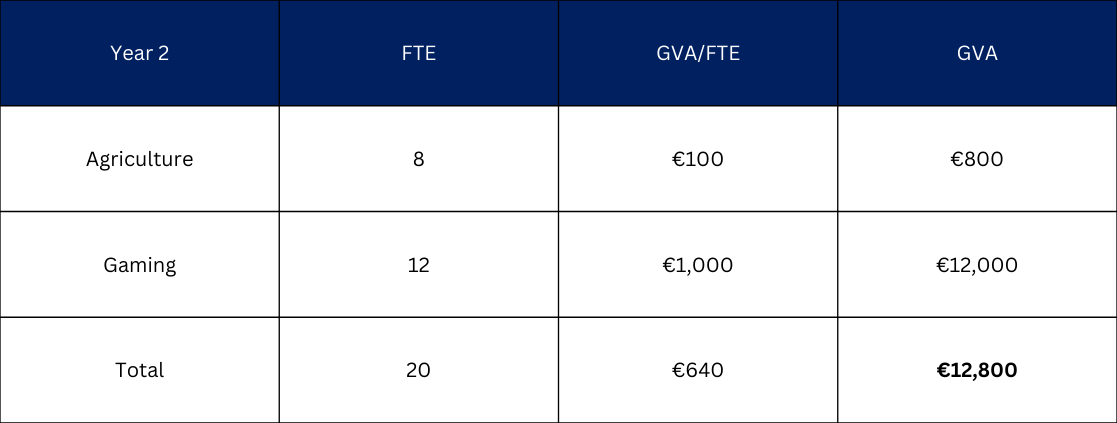
Now let’s say that in following year, 2 Agriculture workers shift to Gaming. The figures are the following; the total output of the economy increased by 16.4% to €12,800 and the average GVA per FTE at a national level also increase by 16.4% from €550 to €640. However, note that productivity or GVA per FTE per sector remined exactly the same for both sectors at €100 and €1,000 respectively. Also, the total number of employees within the economy remained the same at 20 FTEs. So, this growth in output was purely the derivative of economic transformation.
This highlights an important point. As clearly demonstrated by the above example it is actually "easier" for a country to grow its economy by moving workers from lower value sectors to higher value sectors, than it is to make, for example, a farm 10x more productive.
Back to the Maltese economy, as one can imagine, providing the full calculations for economic transformation between 2014 and 2024, given the number of different sectors is extremely complex. So, in this article, I will only provide the headline figures.
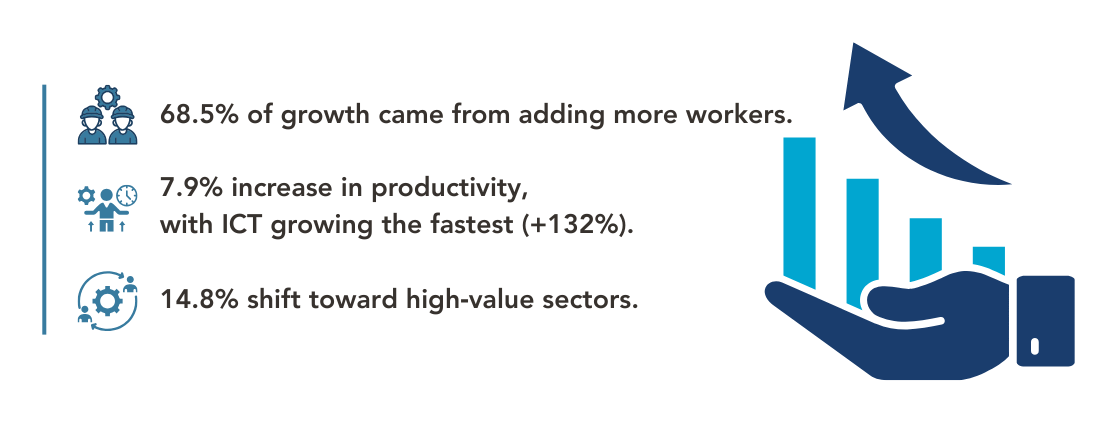
Between 2014 and 2024 the economy grew by 91.15%. 68.5% of this was from increase in employment. Then there is the second part, Productivity. Between 2014 and 2024, 6 out of the 10 economic sectors experienced an increase in GVA per employee. Most notable increases in productivity came from Information and communication with an increase of 132% followed by manufacturing with an increase of 24%. On the other hand, the 4 sectors that did not register any increase in GVA per employee were Construction and linked with that Real Estate and perhaps surprisingly, Financial & Insurance activities and the sector containing Gaming. When we weigh the changes in productivity per sector according to its share within the economy, over the 10 year under review, weighted average productivity increased by 7.88%. So collectively the increase in workforce at 68.50% and increase in weighted average productivity at 7.88% bring the total to 76.38% out of the total growth of 91.15%. The remaining economic growth was from economic transformation, the shift from lower productivity sectors to higher productivity ones. By way of an example, the Information and Communication sector (the sector with the highest GVA per FTE if we exclude real estate) in 2014 accounted for 6.1% of the economy but its share increased to 13.1% by the end of 2024. Likewise, the share of professional services sector increased from 11.2% in 2014 to 17.3% in 2024. This transition from lower productivity sectors to higher productivity sectors contributed to a total of 14.77%.
The interesting part is that had the economy not transformed to higher output sectors between 2014 and 2024 the size of the economy would have amounted to €15.2B as opposed to the actual of €17.8B, a reduction of €2.6B.
Finally I would like to conclude on this point. This article shows that economic transformation is crucial for an economy to grow without increasing labour or productivity. However, policy makers should not fall into the trap that they guide the economy into specialisation of a few sectors as this would reduce diversification and security (such as in the case of agriculture which although is a low productivity sector should be given the utmost importance), something that kept us going during difficult times such as the pandemic. Instead, the economy should be diversified into as many high productivity niches as possible, resulting in higher aggregate output as well as having the safety net of diversification. This does not mean that Malta should not work hard into also improving its labour productivity as ultimately, if we are to maintain a diversified economy boosting labour productivity in all sectors as much as possible will also be a way of ensuring sustainable economic growth.