

Globalisation has left a strong imprint on the Maltese economy, and nowhere is this more evident than in the role of foreign-controlled enterprises. According to data published by National Statistics Office (Malta) in its Foreign Affiliates Statistics 2023 release, only a small share of enterprises in Malta are under foreign control, but their contribution to economic output is anything but small.
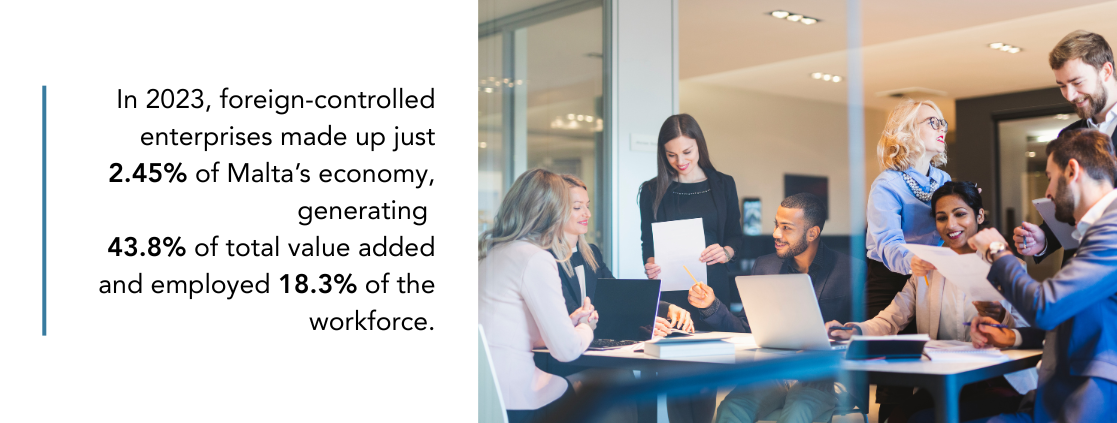
In 2023, Malta counted a total of 54,867 enterprises (non-financial business), of which just 1,343 (2.45%) were foreign-controlled. While representing less than three per cent of all businesses, they accounted for 43.8% of the total value added in the Maltese economy. Moreover, they employed 18.3% of the total workforce, confirming their central role in job creation and economic activity.
Foreign ownership is particularly dominant among Malta’s largest businesses. Of the 193 large enterprises operating in Malta, 102, or 52.8%, are foreign-controlled. This illustrates that foreign affiliates are not just present in niche sectors but are at the heart of Malta’s corporate structure, especially at the upper end of the size scale.
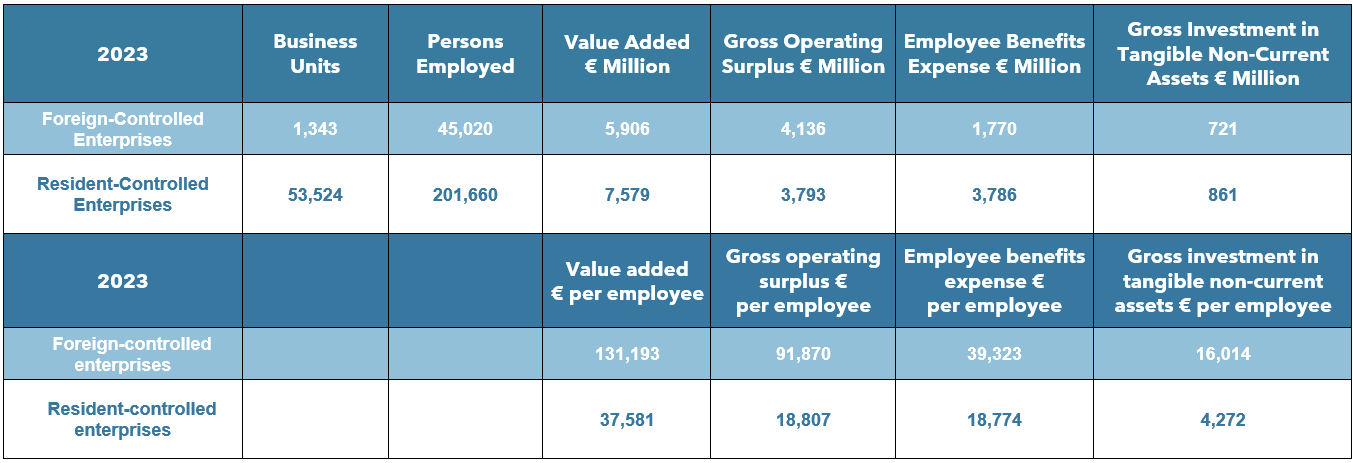
The economic weight of these companies becomes even clearer when looking at productivity and pay. The average value added per employee in Malta in 2023 stood at €54,665. But foreign-controlled enterprises far exceeded this figure, generating €131,000 per employee, compared to just €38,000 in resident-controlled firms. In other words, foreign affiliates generate more than three times the value added per worker than their locally controlled counterparts.
This productivity gap is reflected in remuneration levels. Foreign-controlled firms pay nearly double the average wage, with an average of €39,000 per employee, compared to €19,000 in resident-controlled enterprises. Profitability shows a similar pattern. Foreign-controlled enterprises generate around €92,000 in profits per employee, compared to just €19,000 among resident-controlled firms. This means that foreign affiliates are nearly five times more profitable on a per-employee basis.
Investment patterns also follow this trend. Foreign-controlled enterprises invested about €16,000 per employee in 2023, almost four times more than the €4,000 invested by resident-controlled enterprises. This suggests that foreign affiliates not only operate at a higher productivity level but also reinvest significantly in their operations, supporting further growth and innovation.
To conclude, the data clearly show that foreign-controlled enterprises generate a virtuous cycle of investment which leads to higher productivity, value added, and profitability which in turn leads to higher investment again. This reinforces the need for Malta to pursue a stronger, more strategic drive to attract foreign direct investment in sectors that create quality jobs and foster innovation. Strengthening Malta’s FDI appeal is essential to achieving the ambitions of Vision 2050, building a more competitive, sustainable, and high-value economy deeply integrated into global markets.
Compiled and written by Kurt Muscat Manager, EMCS Advisory Services